Wood Rot Repair vs. Full Replacement: Which Do You Need?
When can rotted wood be saved with epoxy, and when must it be replaced? Structural thresholds, cost trade-offs, and longevity for CT homes.
We see the same debate over wood rot repair vs replacement happen on almost every exterior project.
Homeowners notice a soft spot on their trim and immediately wonder if they can patch it or if the whole board needs removal. This decision often comes down to understanding the structural limits of the material. Our team at Handy Man West Hartford focuses on fixing the root cause first.
We will break down exactly when specialized epoxy makes the most sense and when full replacement is the only safe option. The data shows clear points where full replacement becomes mandatory. Let’s explore the cost differences and explain the exact field assessment process used on every job.
When epoxy repair is the right call
Our approach to wood rot repair relies heavily on two-part epoxy consolidant and hardener for specific situations. This method is genuinely useful, yet it requires a narrow set of correct applications to succeed. The repair is highly effective if the damage meets three strict criteria.
Ideal Conditions for Epoxy
We only recommend chemical consolidation when the physical conditions guarantee a permanent fix. Applying these products over active leaks will simply lead to a failed patch next season. You should look for these specific factors before choosing to patch rather than replace:
- Limited Extent: The rot must impact less than 30 percent of the board’s total cross-section.
- Non-Structural Use: The affected wood cannot carry any weight or support other framing members.
- Resolved Moisture: The original source of the water intrusion must be completely fixed.
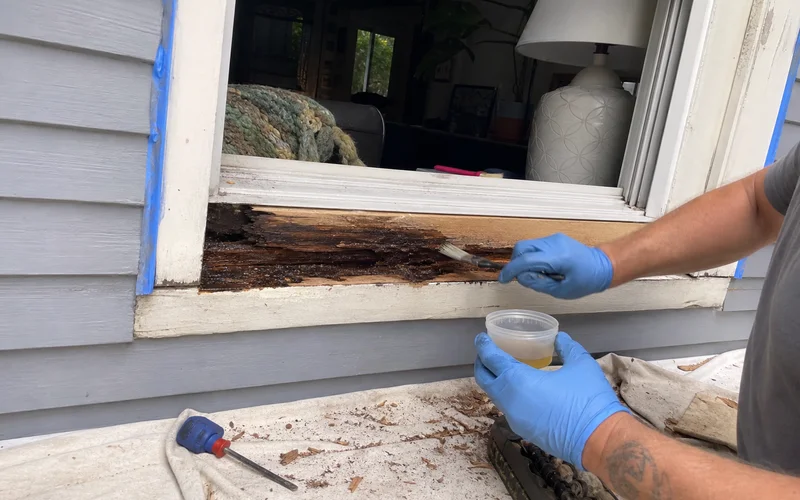
Our carpentry team follows a strict process to ensure these repairs hold up over time. Workers chisel out the softest material and saturate the remaining wood fibers with a liquid consolidant. The void is then packed with structural epoxy, shaped to the original profile, and sanded smooth.
Products and Performance Data
We regularly rely on specific professional-grade formulas to get the job done right. Abatron’s LiquidWood consolidant and WoodEpox system is the top choice for larger exterior restorations. This system boasts a compressive strength of up to 3,000 PSI, making the cured patch stronger than most softwoods.
Our crews appreciate the 20 to 30-minute pot life, which allows plenty of working time before the epoxy hardens in about one to two hours. Smaller repairs often receive treatments using Minwax High Performance Wood Hardener and Wood Filler.
Properly executed patches become completely invisible under primer and paint. We consistently see these high-quality epoxy repairs last 15 years or more in New England weather.
When replacement is the only answer
Replacement becomes the only safe answer when decay threatens the structural integrity of your home. Applying filler to a heavily degraded board is just a temporary patch that will fail within a single season. Our contractors draw a hard line when inspecting damaged framing or extensive exterior rot.
Load-bearing elements like sill plates, deck ledgers, and porch stringers require full structural strength to meet residential building codes. Decay fungi become highly active and rapidly destroy wood fibers when moisture content remains consistently above 28 percent.
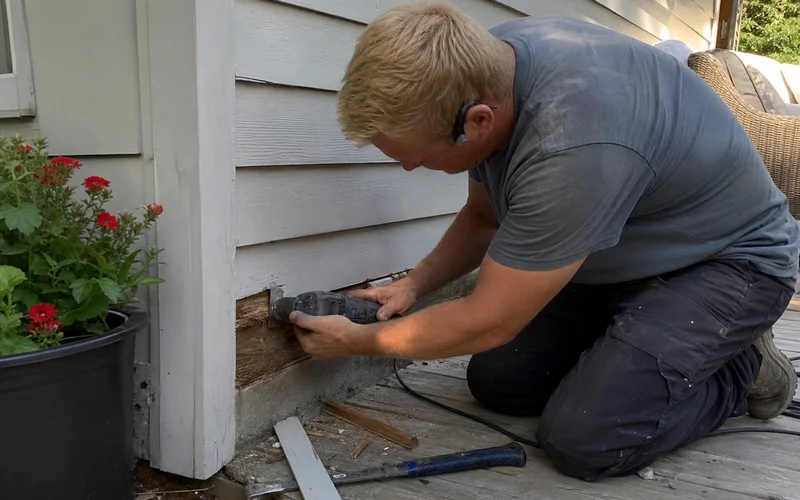
We pull out the pry bars and saws the moment a structural member shows signs of softness.
Signs You Need New Wood
Safety protocols require total replacement if you spot any of the following issues:
- Structural Damage: The soft spots have reached a load-bearing joist, rim board, or carrying beam.
- Extensive Spread: More than 40 percent of a trim board’s cross-section has turned spongy.
- Deep Penetration: The decay has migrated across multiple joints or deep into the end-grain.
- Unresolved Leaks: The original water source cannot be permanently fixed, guaranteeing future failure.
These severe conditions guarantee that a chemical patch will inevitably fail. Our replacement process always focuses on preventing the same damage from happening twice.
A compromised deck ledger or carrying window sill must be swapped out for high-quality, pressure-treated stock. Modern building standards often specify ACQ, which stands for Alkaline Copper Quaternary, for these critical exterior framing applications.
Upgrading to Resilient Materials
We make sure the new installation is heavily protected with proper metal flashing and modern elastomeric sealants. This comprehensive approach stops water from ever reaching the vulnerable end-grain again.
You get a permanent solution instead of returning to the same rotted corner two years later.
Cost trade-offs
Our pricing model reflects the reality of skilled labor and high-quality materials required for lasting results. Evaluating the financial side of a project means looking at both immediate pricing and long-term value.
A quick patch job looks cheaper on paper, but only if the damage fits the strict criteria for a chemical fix.
Comparing Immediate Expenses
We created the table below to give you a realistic sense of what each approach costs on a typical job. These figures reflect the current market for licensed professionals operating in the area. A fully insured carpentry contractor typically bills between $85 and $130 per hour to cover wages, overhead, and insurance.
| Scope | Epoxy repair | Replacement |
|---|---|---|
| Small trim spot (2 ft) | $250 to $450 | $400 to $700 |
| Full trim board | $500 to $900 | $600 to $1,000 |
| Window sill | $400 to $700 | $700 to $1,200 |
| Structural sill / ledger | Not appropriate | $1,500 to $4,000+ |
Our estimates clearly show that putting in fresh lumber requires a larger upfront investment. The higher price tag accounts for the extra time spent removing old material, modifying adjacent siding, and installing new flashing.
Choosing a full replacement completely eliminates the risk of that exact same board rotting out again.
Material Upgrades and Value
We frequently recommend upgrading to modern synthetic materials during the replacement process. Swapping a rotted pine board for a cellular PVC product like Azek increases material costs by about 15 to 20 percent.
This initial bump in price buys you a permanent exterior feature that is completely impervious to insect damage and decay. Our clients often find that spending slightly more today saves thousands in future maintenance.
The long-term savings make full replacement the smarter financial move for any recurring trouble spots. You avoid paying a crew to come back and fix the same corner two years down the road.
How we decide on the walk
Our estimators use specialized tools and years of field experience to uncover hidden damage. Every project begins with a detailed, on-site evaluation to determine the exact scope of the decay.
Visual inspections are never enough when dealing with water intrusion and failing building materials.
The Diagnostic Process
We physically probe the extent of the soft wood using a standard screwdriver and a sharp pick tool. A dual-depth digital moisture meter is then used to scan the surrounding boards for hidden water retention.
Readings above 20 percent moisture content tell us that conditions are ripe for active fungal growth. Our next priority is tracking down the specific mechanism that allowed water into the assembly in the first place.
Common culprits in the US Northeast include failed step flashing, neglected caulk joints, or winter ice-dam damage. A repair cannot move forward until this underlying mechanism is fully resolved.
Making the Final Call
We compile all these diagnostic details to determine if the compromised member is structural or purely cosmetic. The collected data allows us to present a clear, fact-based recommendation for your specific situation.
Clients receive a detailed breakdown that outlines whether an epoxy patch, a full tear-out, or a hybrid approach works best. Our quotes always include a firm price for each viable option to help you make an informed decision.
Many homeowners struggle to determine if their siding is rotting or if pests are involved. If you need help identifying the problem, reading up on the differences between decay and termite damage is a great place to start.
We encourage you to schedule an evaluation as soon as you spot peeling paint or soft trim. Taking immediate action is the best way to protect your property and keep repair costs under control. Call the office today to get an expert set of eyes on your home exterior.